


Businesses are under constant pressure to adopt new technologies, but speed without structure can lead to costly missteps. According to McKinsey, nearly 70% of digital transformation initiatives fail, often due to poor planning and lack of adoption.
A digital transformation framework acts as a strategic guide, aligning technology investments with business objectives and enabling sustainable change across departments. It helps organizations avoid fragmented efforts and ensures that digital tools deliver measurable impact.
| As Nahjee Maybin, CEO of Kenyatta Computer Services, puts it: “A well-planned digital transformation gives businesses the structure to grow efficiently while adapting to customer needs.” |
By applying a structured framework, companies can sidestep common pitfalls, maintain clear alignment across teams, and unlock the full potential of digital solutions.
This blog explores key components, framework types, and actionable steps to help you create a transformation strategy that drives visible results.
What is a Digital Transformation Framework?
A digital transformation framework is a structured approach for implementing technology-driven change across your organization.
Unlike general business transformation frameworks, which focus on operational or strategic shifts, the intention behind digital transformation methodology is for the process to be continuous. It emphasizes ongoing adaptation, iterative improvements, and long-term alignment with business objectives.
The framework serves as a roadmap, ensuring your digital investments address real business problems. It aligns technology initiatives with measurable goals, such as improving operational efficiency, customer experience, or revenue growth.
You should see it as a living guide that evolves with technology, market demands, and organizational needs.
When you define clear milestones, responsibilities, and success metrics, the framework reduces risks, prevents fragmented adoption, and ensures your transformation delivers lasting results.
Core Components of a Digital Transformation Framework
A robust digital transformation framework is built on five core pillars: people, data, insights, action, and outcomes. Each plays a critical role in delivering measurable value.
1.People
Your team drives success. A framework without the right talent and leadership behind its technology will fail. Focus on building internal capabilities, hiring skilled personnel, and ensuring leadership actively supports the transformation.
Adoption is a major challenge. Employees need training, clear guidance, and ongoing engagement to embrace new processes. Leaders should communicate the value of change and actively demonstrate commitment.
Involving teams in decision-making strengthens buy-in and encourages ownership. A strong people strategy ensures technology integrates smoothly into everyday workflows.
2.Data
Data is the backbone of transformation. Collect, store, and process information systematically. High-quality, accessible data enables decision-making across departments. Integrate systems to avoid silos and maintain accuracy.
Regular audits ensure compliance with privacy and security standards, such as GDPR or HIPAA. Reliable data supports predictive analytics, better resource allocation, and improved customer experience.
Without structured data, even the most advanced technology solutions fail to deliver meaningful results.
3.Insights
Turning raw data into actionable insights is critical. Analytics tools, AI models, and reporting dashboards help you detect trends, predict challenges, and identify opportunities. However, insights are only valuable if applied to decision-making.
Establish clear processes to interpret analytics, test hypotheses, and act based on evidence. Insight-driven actions reduce guesswork, optimize operations, and improve outcomes.
4.Action
Insights alone do not change outcomes. Your digital transformation framework must include actionable steps. Implement technology with clearly defined objectives, monitor progress, and adjust strategies as needed.
Introduce structured workflows, project ownership, and accountability measures. Action also involves integrating change management strategies to ensure employees understand, adopt, and sustain new tools and processes.
5.Outcomes
Measure results to verify your efforts. Define KPIs, track them regularly, and refine processes based on findings. Outcomes feed back into the framework, creating a continuous improvement loop.
When assessing success, ensure investments generate measurable business value and support strategic goals. Tracking outcomes also helps justify future initiatives and secure stakeholder support.
Types of Digital Transformation Frameworks
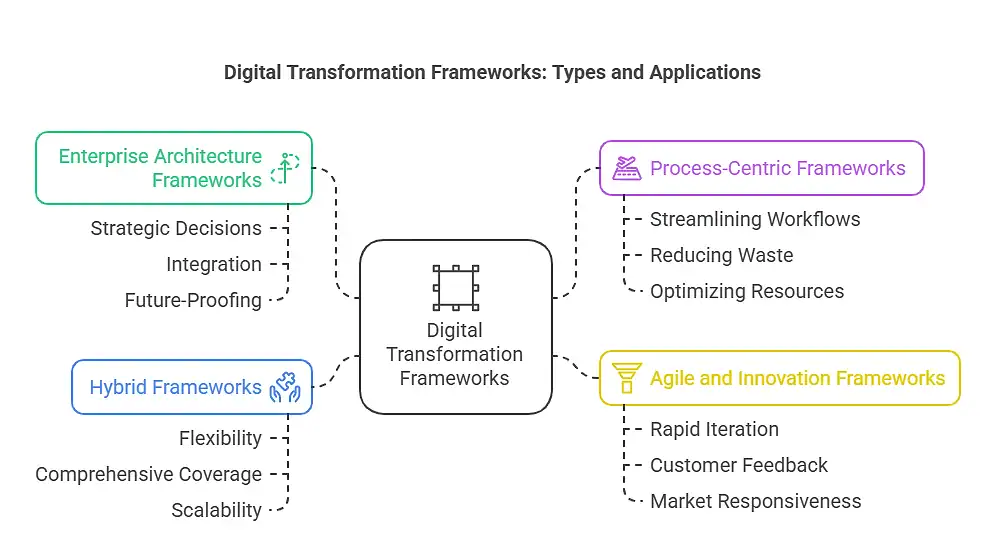
Different organizations require different approaches. Selecting the right model is crucial to success.
1.Enterprise Architecture Frameworks
57% of businesses say outdated infrastructure directly slows productivity and stifles innovation. Digital transformation frameworks focus on aligning IT systems with business strategy. They provide structure, standardization, and visibility across your technology infrastructure.
Enterprise architecture frameworks support strategic decisions, improve integration, and future-proof IT investments. They are especially suitable for complex organizations with diverse systems. The Zachman Framework is a popular example. It defines enterprise architecture across multiple stakeholder perspectives.
2.Process-Centric Frameworks
69% of IT leaders see digital transformation mainly as a tool for boosting process efficiency. Process-centric models focus on operational efficiency. They streamline workflows, reduce waste, and optimize resource utilization.
Lean Six Sigma DMAIC is a widely used methodology. It identifies problems, implements targeted improvements, and ensures ongoing process refinement. Industries like manufacturing, logistics, and healthcare benefit significantly, as streamlined operations directly impact performance and customer value.
3.Agile and Innovation Frameworks
Agile frameworks prioritize adaptability and rapid iteration. They allow businesses to test ideas, gather feedback, and respond quickly to market changes.
Agile methodologies break work into short cycles, enabling faster delivery and continuous improvement. Teams stay aligned with customer needs and emerging trends, ensuring innovations deliver tangible results.
Tech startups and product-driven businesses benefit the most, but any organization seeking responsiveness can apply these principles.
4.Hybrid Frameworks
Hybrid frameworks combine elements of multiple approaches to meet complex organizational needs. They offer flexibility, comprehensive coverage, and scalability.
For example, a global healthcare company could use enterprise architecture for infrastructure, Lean Six Sigma for operational processes, and Agile for customer-facing applications.
This combination ensures alignment across departments while supporting innovation and efficiency.
| More resources you might like: |
5 Steps to Build a Digital Transformation Framework That Works
A digital transformation framework only succeeds when it is practical, measurable, and adaptable.
These five steps provide a clear structure for building and sustaining meaningful change.
- Assess business needs and technology gaps: Begin by identifying gaps in current operations. Evaluate processes, infrastructure, and digital maturity. Understanding these gaps helps you prioritize initiatives that deliver the greatest impact.
- Align with a technology strategy framework: Connect your digital transformation framework with a broader technology strategy framework to ensure digital investments support business goals, prevent wasted effort, and maintain strategic alignment.
- Build a roadmap with measurable outcomes: Develop a step-by-step roadmap. Set clear milestones, define deliverables, and establish KPIs. Measurement ensures accountability and enables you to track progress effectively.
- Include change management and adoption strategies: Address human factors early. Communicate goals clearly, provide training, and build leadership support. Integrate change management into every stage to maximize adoption and reduce resistance.
- Monitor, adjust, and scale: Digital transformation is iterative. Monitor outcomes, collect feedback, and adjust strategies. Scale successful initiatives across teams, regions, or business units to maximize value.
Benefits of Using a Digital Transformation Framework
A structured approach to digital change delivers more than just new tools. It creates consistency, alignment, and measurable outcomes across your business.
- Clear strategic direction and alignment: A digital transformation framework connects every initiative to measurable goals. You avoid fragmented efforts and ensure that technology delivers business value.
- Improved efficiency: A digitalization framework optimizes workflows, automates routine tasks, and allows staff to focus on higher-value activities. This reduces costs and improves productivity.
- Better decision-making with actionable insights: Structured data collection and analytics provide insights for informed decisions. You can predict trends, identify risks, and seize opportunities faster than competitors.
- Stronger collaboration across teams: Frameworks foster cross-departmental collaboration. Shared tools, goals, and dashboards improve communication, reduce silos, and increase alignment.
- Scalable, repeatable approach: The framework supports replication across departments or regions. You can scale processes and technology while maintaining consistency and strategic alignment.
Common Pitfalls In Creating a Digital Transformation Framework and How to Avoid Them
Digital transformation promises growth, but without the right foundation, it can quickly derail. Avoiding common missteps ensures your strategy delivers lasting value and meaningful change across the organization.
- Focusing only on technology: Many businesses adopt new tools without changing processes or workflows. Integrate technology with operations to maximize results.
- Overlooking adoption and change management: Without active leadership and employee engagement, transformation fails. Implement structured communication, training, and leadership support.
- Choosing the wrong frameworks: Not every methodology fits all organizations. Select frameworks based on your industry, size, and goals to maximize impact.
- Ignoring feedback loops: Continuous improvement is essential. Use KPIs and employee feedback to refine processes and prevent stagnation.
Real Case Examples of Successful Digital Transformations
Real-world results show how a structured approach to digital transformation delivers measurable outcomes. The following case studies highlight how Kenyatta Computer Services (KCS) helped clients overcome complex IT challenges and achieve scalable growth.
1.Nationwide POS Upgrade for Natural Grocers
Natural Grocers, a leading health food chain with locations across the U.S., needed support for a nationwide point-of-sale (POS) system upgrade. Their internal IT team could not handle the scale of the project on its own.
Kenyatta Computer Services (KCS) provided staff augmentation services, including system imaging, logistics coordination, scripting, and a dedicated traveling team that installed the upgrades across multiple states. This approach ensured quality and consistency throughout all locations.
Natural Grocers met its tight 4-month deadline, reduced operational risks, and maintained focus on core business activities while successfully rolling out the upgraded POS infrastructure.
2.Standardized IT Infrastructure for MyFitFoods
MyFitFoods, a growing meal-prep and wellness brand with locations across the U.S., needed a reliable IT infrastructure that could scale with its rapid expansion. Their challenge was maintaining consistency and providing on-site support nationwide without building a costly in-house IT team.
KCS designed and implemented a standardized IT infrastructure across all MyFitFoods locations and provided access to a nationwide team of technicians able to respond within 48 hours. This ensured operational continuity, improved training processes, and reduced downtime.
The solution gave MyFitFoods the efficiency and scalability required to expand quickly while keeping IT costs manageable. With KCS’s support, the company built a strong foundation for long-term growth and reliable customer service across its nationwide footprint.
Mapping Digital Transformation Framework to Business Goals
To better understand practical application, the table below outlines how key components of a digital transformation framework support specific business objectives.
This table demonstrates how each element drives tangible business value and reinforces the importance of structured frameworks.
| Component | Business Objective | Key Action | Expected Outcome |
| People | Adoption and Engagement | Training programs, leadership support | Increased buy-in and productivity |
| Data | Accurate Insights | Data centralization, real-time analytics | Better decision-making |
| Insights | Strategic Decisions | Analytics dashboards, predictive modeling | Optimized operations |
| Action | Operational Execution | Clear workflows, process integration | Reduced errors, faster results |
| Outcomes | Value Measurement | KPIs and reporting | Continuous improvement and measurable ROI |
Monitoring these metrics helps prove value to stakeholders and guides continuous improvement.
Achieve ROI-Driven Transformation with Kenyatta Computer Services
A well-executed digital transformation framework ensures alignment between technology, people, and business goals. By focusing on people, data, insights, action, and outcomes, you create a continuous cycle of improvement and measurable results.
Kenyatta Computer Services has helped clients implement structured digital transformation methodologies, achieving faster adoption, improved productivity, and clear ROI.
With over 33 years in business, our approach has enabled companies to scale digital initiatives effectively, with measurable performance improvements.
| Discover Trusted IT Consulting Services in Denver, Colorado |
Contact us today to evaluate your digital journey, adopt a proven digital transformation framework, and accelerate business growth.